Corrected details revert later
A confirmed address fix disappears after another system sends an older record. Staff repeat the edit without knowing which connection brought the old value back or why it was accepted.
System integrations & custom APIs
A corrected address disappears after the next sync, and another team restores its version. Staff keep repairing the same customer record. We set field ownership, trace older updates and add supported conflict handling, so updates have a clear business owner.
Discuss this problemWe compare a small history of customer updates across the affected systems, with values redacted where possible. Recorded times help, but we must check what they mean and whether they are reliable. Sales, service and finance may each own different fields on the same record. Before we change how the sync behaves, the plan sets out who owns what, how deliberate deletions work, and what happens with unclear conflicts. Getting overwritten values back depends on the history you have kept and the record owner's approval.
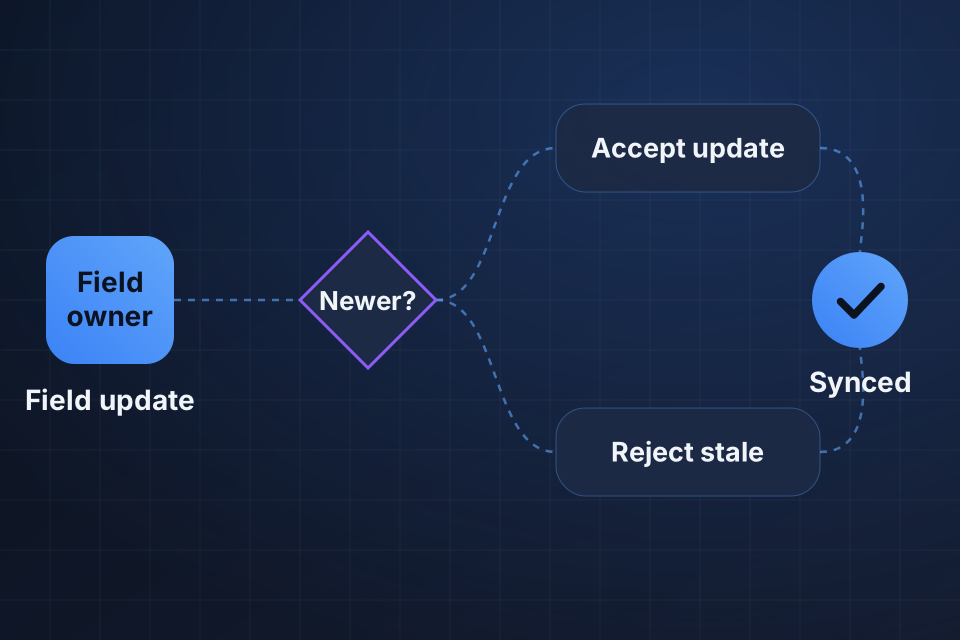
A confirmed address fix disappears after another system sends an older record. Staff repeat the edit without knowing which connection brought the old value back or why it was accepted.
Departments correct the same contact differently, then the sync reverses their work. Each system briefly shows its preferred value, while the shared customer record stays inconsistent and hard to explain.
An incomplete record replaces filled-in details with blanks. The update treats a missing value as a deletion, even though nobody approved removing that information from the official customer record.
We check when each value changed and which application made the change. Update logs and record versions help separate an old update arriving late from a real correction made in another system.
We agree who owns specific customer fields and how conflicts get resolved. One record can hold information kept by different teams, so giving one system authority over the whole record may be the wrong fit.
We look at how customers are matched and how much each update writes. Replacing a full record can overwrite unrelated newer fields, and missing data may be confused with a deliberate request to clear a value.
We set up field-by-field authority using the controls your integration supports. Each mapped value follows the approved business source, not whichever connected system happens to send its update last.
We protect supported updates with suitable ordering or version checks. Where timing can't show the correct value, conflicting updates go to review instead of silently replacing accepted information.
We revise update mappings so they touch only the intended fields. Missing data and deliberate deletion follow separate agreed rules. When the owner approves, we use kept history to recover overwritten values.
Yes, where their responsibilities are clear. We define ownership or conflict handling field by field and test changes made at the same time. Staff should understand when a local edit will carry across, stay local or need another team's approval.
No. Recorded timestamps can mean different things, or show when a message arrived and not when the original edit happened. We check those details and any available versions before using time as authority. Business ownership or manual review may be needed when the order of events is unclear.
Only if you still have history or another trustworthy source for the earlier value. We identify the evidence available and ask the record owner to approve restoring it. A mismatch today is not grounds to invent an address or assume an older value is correct.
Tell us which customer platforms are connected and one affected field. Share a redacted example of a newer value reverting, with the update times, so we can identify the competing updates.
Explore System Integrations More problems in System integrations & custom APIs
Tell us about your project and we'll get back to you within 24 hours.