Sale prices reach one channel first
The store discounts a product while the submitted data keeps its regular price. Staff edit the feed by hand, but the next scheduled export brings back the value from an unchanged pricing source.
Google Merchant Center
A discount reaches your store while the feed shows another amount, or the offer ends at different times. Staff patch exported values without fixing the cause. We trace promotion rules and timing, so the submitted offer describes what shoppers see.
Discuss this problemWe review how the promotion is set up, which products qualify, and whether the discount shows on the product page or depends on a condition at checkout. We compare when the feed is built with when the storefront publishes, around the offer's start and end. Samples at the variant level reveal gaps that a parent product summary can hide. The fix belongs in the pricing source you maintain, or in the way it gets updated. We follow that with price checks on our side and a separate review of the processed item diagnostics.
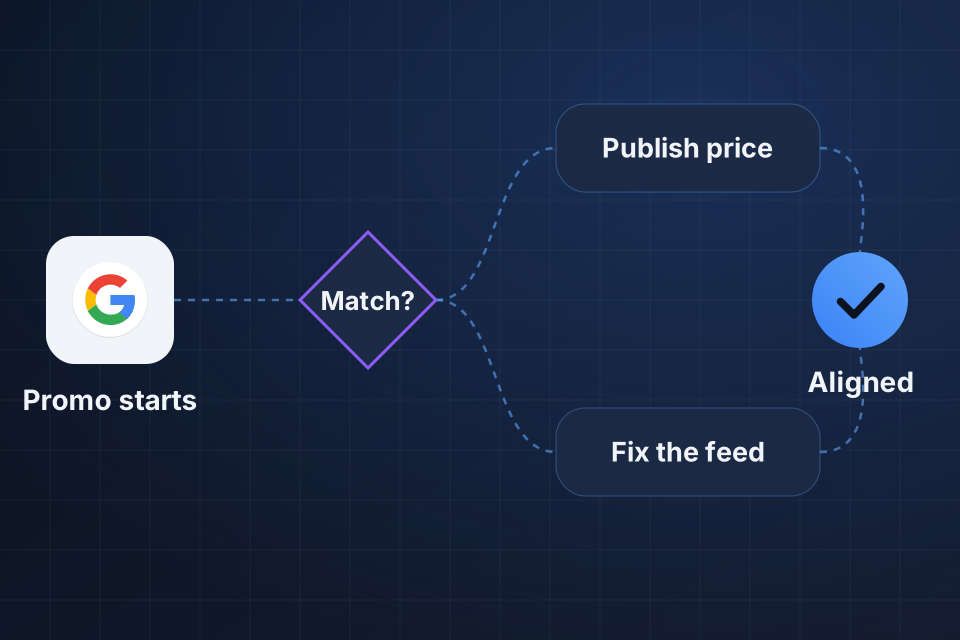
The store discounts a product while the submitted data keeps its regular price. Staff edit the feed by hand, but the next scheduled export brings back the value from an unchanged pricing source.
An offer starts or ends at different times in the store and the feed. Checks done in the middle of the promotion miss the moments when customers run into different prices.
The parent product advertises a discount while certain sizes or configurations stay at the regular price. The summary looks correct, but the individual submitted items don't describe the same offer.
We find the source of the promotion and how it applies to each product. We separate displayed price cuts from coupon or cart-based offers before deciding which submitted fields should describe them.
We compare scheduled exports, storefront changes and the offer's set start and end. That shows whether the correct value is delayed, removed too early or replaced by an older pricing source.
We sample qualifying and excluded variants against the actual promotion rule. Item mappings can make the store and feed describe different eligibility, even when the promotion as a whole looks correctly set up.
We fix the generated pricing values at the source you maintain. Supported promotion fields follow how the offer really works, and later exports keep the intended amount without repeated manual patches.
We coordinate supported publishing around launch and expiry, and we document the expected delay. We check both ends, so the fix doesn't trade a late start for an expired offer that lingers afterward.
We provide a focused comparison of affected feed items and live product options. Your merchandising team can find the pricing source behind a mismatch before launch and use the same check after expiry.
No. A condition at checkout differs from a sale price shown to everyone. We check who really qualifies and what the platform requires for promotions before choosing which fields to submit. The result should describe the offer a shopper can get, and not treat every coupon as a discount with no conditions.
We check whether your current schedule can support the offer start and end times your team needs. A faster supported update or a different launch plan may be appropriate. We keep publishing delays documented, so your merchandising team can check the actual start and end and not assume instant syncing.
Not necessarily. The work addresses the confirmed pricing mismatch. Other item or account requirements can still affect eligibility, and the review stays with the platform. We compare the corrected values locally, then look at processed diagnostics to see whether the original issue or another problem remains.
Tell us your storefront and feed platform, then share one public product option and a redacted submitted price showing the mismatch. Include the promotion rule and the rough start or expiry time.
Explore Google Merchant Center More problems in Google Merchant Center
Tell us about your project and we'll get back to you within 24 hours.