eBay: Integrations

Every order your team retypes from eBay is another chance for a typo. Connecting your systems removes that step.

Ending the Copy and Paste

Your eBay orders need to reach fulfillment and accounting. Inventory has to come from your master catalog, and customer details belong in your CRM or email platform. When someone on your team moves that data by hand, the work never ends.

We build the integrations that connect eBay to the rest of your systems. Data moves between them on its own, and your team stops copying it from one screen to another.
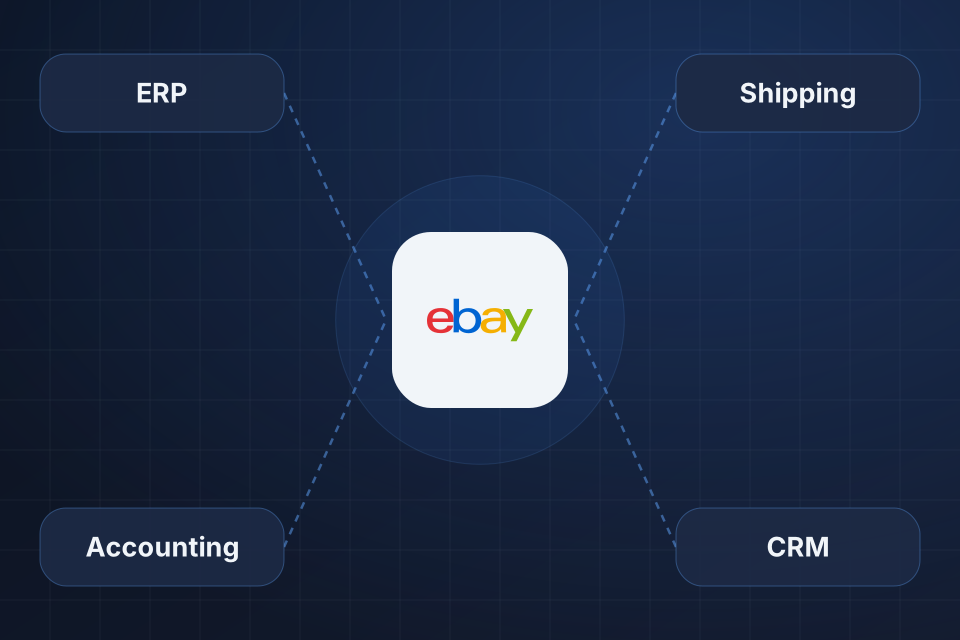
Diagram of eBay at the center, connected to ERP, accounting, shipping and CRM systems.

What Gets Connected

Order sync from eBay to your ERP, accounting or fulfillment system

Inventory and listing sync from your master catalog or product database (PIM)

Shipping platform connections for labels and tracking

Custom integrations built with middleware like Celigo, Zapier or Make

Building the Connection

1

Map Data Flows

We list the orders, stock and customer data that must move between eBay and each of your systems.

2

Pick Connectors

A pre-built connector such as Celigo, Zapier or Make goes in where one fits. Unusual requirements get custom code.

3

Build and Tune

Batching and scheduled syncs keep the integration within eBay’s API limits, even on high-volume accounts.

4

Add Monitoring

Alerts go in last, so your team hears about a failure before your customers do.

Why Choose System Strats

We work across Shopify, BigCommerce, WooCommerce, Amazon and back-office systems like NetSuite. That broader view means your eBay integrations fit the rest of your business instead of creating more work.

Frequently Asked Questions

Common ones include ERPs like NetSuite, accounting tools like QuickBooks, ecommerce platforms like Shopify, shipping tools like ShipStation, PIMs and CRMs. If a system has an API, a way for software to connect, we can usually link it.

Both. Pre-built connectors are faster and easier to maintain when they fit, and we use tools like Celigo, Zapier or Make on many projects. Complex or unusual requirements get custom integrations.

We design around them from the start, using batching, scheduled syncs and efficient queries. For high-volume accounts, we tune the integration to stay well within the limits.

Your team knows about it before your customers do, because we build monitoring and alerts into every integration. We also have processes for getting things back online quickly.

Ready to Get Started?

Tell us about your project and we'll get back to you within 24 hours.