Where your data lives decides how fast you can use it and what it costs to keep.
Reports are slow, your database struggles at busy times, or data sits where your team can’t query it. AWS offers plenty of services for this, including RDS, Aurora, DynamoDB, Redshift and S3, which makes choosing the hard part.
We design data architectures that use the right service for each job. Your data stays reliable, performs well and is easy to query.
We manage your RDS and Aurora databases
A DynamoDB data model built for how you use it
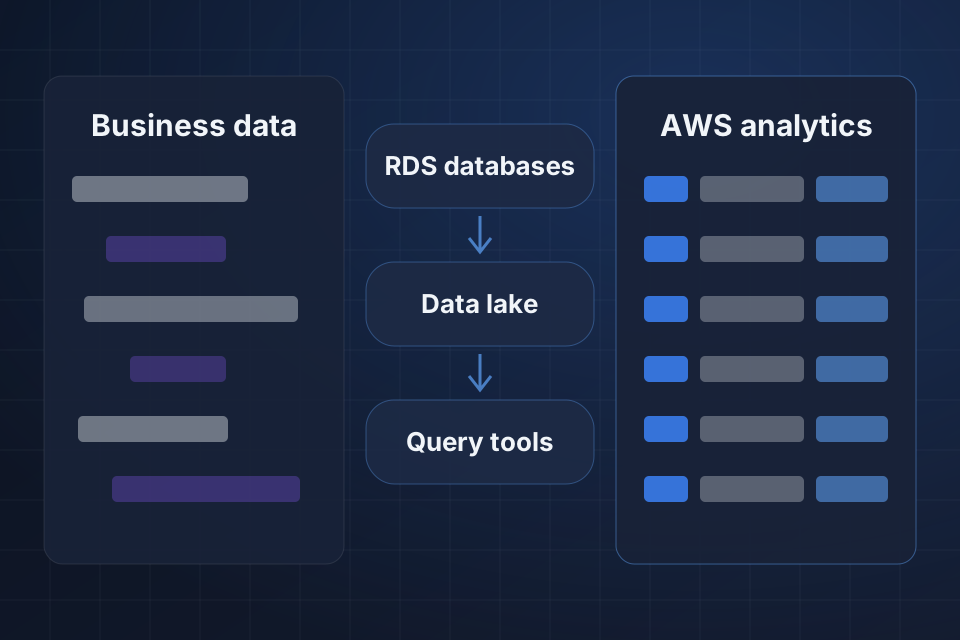
An S3 data lake, one central store for raw data
Redshift and Athena set up for your analytics
We look at how your applications read and write data before picking a database.
Aurora suits most production workloads, RDS suits simpler ones, and DynamoDB suits high-scale work with predictable access patterns.
For analytics, we design S3 storage layout, partitioning and catalog to keep queries fast and costs low.
AWS Database Migration Service and related tools move on-premises databases across with minimal downtime.
We run real AWS production workloads across compute, data and serverless, and we know where the platform’s traps live. With data, we model carefully before committing, because the wrong database is costly to undo.
For most production workloads, Aurora. It’s typically faster, more resilient and scales better, at a slightly higher cost. RDS still has its place for simpler use cases.
Use it for high-scale, low-latency workloads with predictable access patterns. It won’t drop in as a replacement for a relational database, so we model carefully before committing.
S3-based data lakes with Athena or Redshift Spectrum work well for most analytics workloads. We design the storage layout, partitioning and catalog to keep queries fast and costs low.
Yes. We use AWS Database Migration Service and related tools to move Oracle, SQL Server, MySQL and PostgreSQL databases with minimal downtime.
Tell us about your project and we'll get back to you within 24 hours.