There’s no single right way to run software on AWS. Each workload deserves its own answer.
Your applications run on whatever was set up first, and you aren’t sure it’s still the right fit. Maybe servers sit idle, or traffic spikes slow everything down.
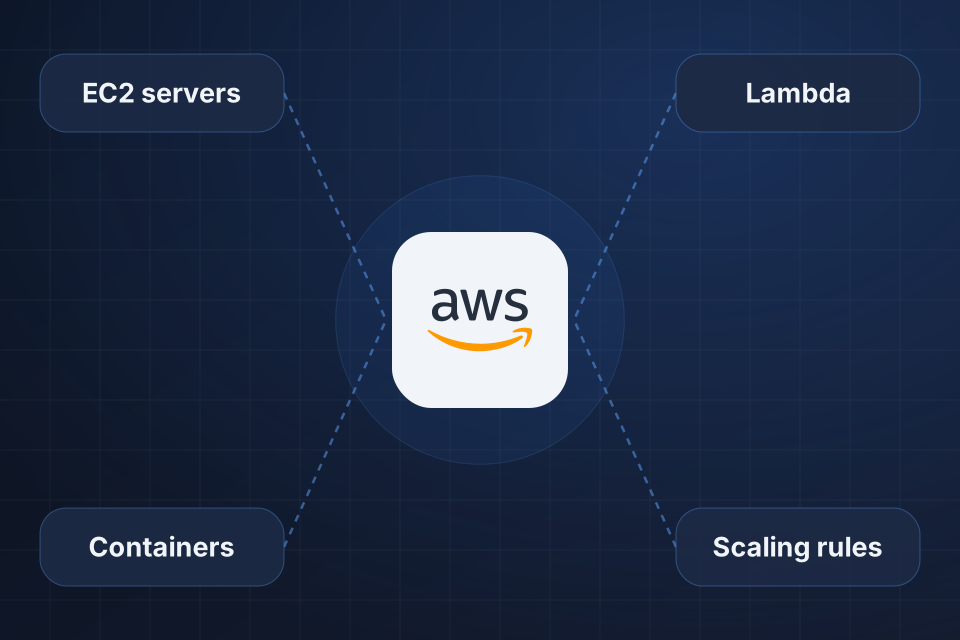
AWS gives you many ways to run software: EC2 virtual servers, ECS, EKS and Fargate for containers, and Lambda for serverless code that runs only when triggered. We pick the right service for each workload and manage the ongoing operations that keep it running.
EC2 and Auto Scaling Group setup
Container workloads on ECS, EKS and Fargate
Serverless setups built on Lambda
Lower costs, whichever way your software runs
We review each workload’s traffic patterns and behavior before recommending anything.
EC2 usually fits traditional software, containers fit modern apps, and Lambda fits jobs that run on a trigger.
Auto Scaling Groups and target tracking policies get realistic limits based on your real traffic.
We handle cluster upgrades, daily operations and cost tuning, whichever way each workload runs.
We run real AWS production workloads across compute, data and serverless, and we know where the platform’s traps live. That’s why we decide workload by workload and skip the one-size answers.
It depends on the workload. Use EC2 for traditional workloads, containers (ECS, EKS or Fargate) for modern applications, and Lambda for event-driven and request-driven work. We choose per workload, with no fixed preference.
Yes. We run EKS environments for clients who need Kubernetes, handling cluster design, upgrades and day-to-day operations.
For variable, event-driven workloads, usually yes. For steady high-traffic workloads, provisioned compute is often cheaper. We analyze yours before recommending either.
We use Auto Scaling Groups, target tracking policies and service-level autoscaling. Scaling limits come from your real traffic patterns, rather than guesses.
Tell us about your project and we'll get back to you within 24 hours.