Filled fields go blank
Required values go blank after the supplier rearranges its page. Staff further down the line see incomplete product records without knowing whether the source removed the information or the scraper simply lost it.
Web scraping
A supplier changes a page and your scraper returns blanks or wrong values. Publishing that can damage your product records. We check authorized source pages, repair the fault we verify and hold incomplete or suspect data back from catalog updates.
Discuss this problemWe compare the affected pages with what the scraper assumed before the change. A value sitting in the expected spot does not prove it is the right value, so we check sample specs and amounts against the source. We also look at the point where data gets published, to see what happens when required data disappears. Corrections use permitted routes, and we retain only limited evidence that suits your arrangement with the source. After the repair, missing-field and wrong-value tests show that a later page change becomes an exception someone can review, not another catalog overwrite.
Required values go blank after the supplier rearranges its page. Staff further down the line see incomplete product records without knowing whether the source removed the information or the scraper simply lost it.
The parser, the part of the scraper that reads each value, picks up unrelated text as a price or spec. A plausible value passes through because the rule assumes the old location still shows what the field means.
A run that technically succeeds publishes empty fields over your maintained catalog values. A temporary source or parsing problem becomes a defect customers can see, not a single exception waiting for review.
We compare samples of the current authorized pages with the parser's selectors and assumptions. That shows what changed and tells a missing field apart from information still present in a different spot.
We check extracted values against their intended meaning and your validation rules. A number can still come from the wrong section, so the source evidence matters along with format checks.
Next we trace incomplete output into the systems that publish it. The review shows whether missing required values stop the record, leave existing data in place or currently overwrite catalog information with no useful warning.
We repair verified parsing for the permitted source structure and test sample fields. Where appropriate, we keep limited sample evidence so later changes can be compared with the approved behavior.
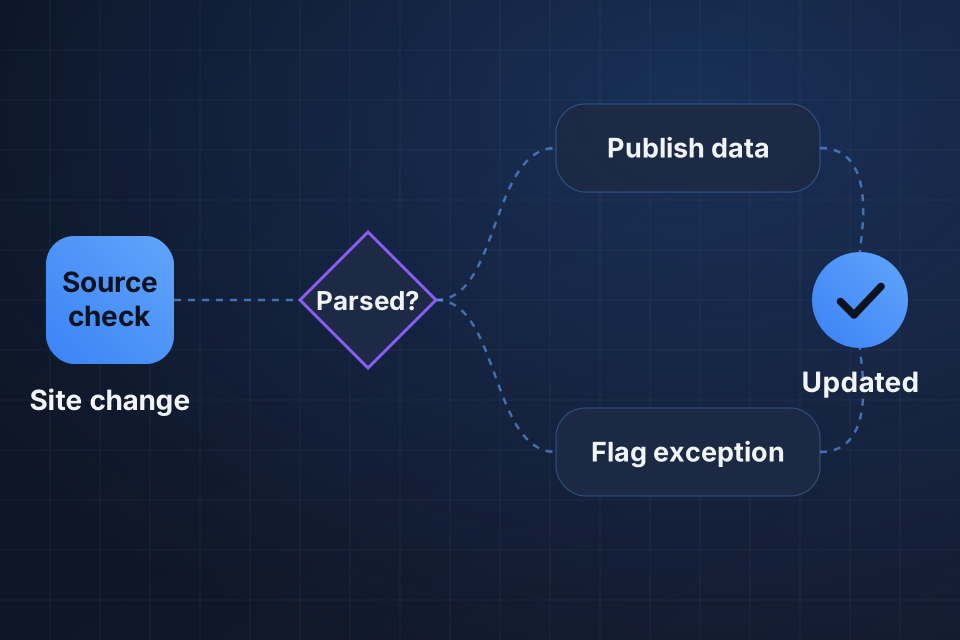
Required and meaningful values get validated before the catalog is published. Suspect records become exceptions, so they do not replace known information with blanks or amounts read from unrelated page content.
Failures caused by source changes show up with the affected references and the reason for each field. Staff can review the supplier dependency or consider an authorized structured feed, and they do not have to find the failure through damaged published products.
Not every time. Sample checks can catch many source changes, but page behavior can vary over time. We make failures visible and protect publishing from suspect output. A maintained parser may still need updates when the supplier has good reason to change how it presents its information.
It can be, because a supported structured feed can reduce your dependence on page layout. Before it replaces your current route, we review its availability, authorization and field coverage. We assess those practical limits and do not assume the supplier offers an equal feed for every product detail you need.
No. We use the limited evidence needed for diagnosis and testing under the approved access arrangement. Retained examples should avoid unrelated or sensitive information. The purpose is to verify the extraction rule, not to collect a whole supplier website without a demonstrated need.
Name the extraction tool and your authorized supplier source. Share one safe page reference that's affected, showing the wrong or missing field with private details removed, so we can compare current source evidence with the parser output.
Tell us about your project and we'll get back to you within 24 hours.