Recovery depends on one employee
Your team waits for one particular person to clear a familiar failure. It turns into a long business stoppage, because nobody else has a tested way to work out the right next step.
Training & managed support
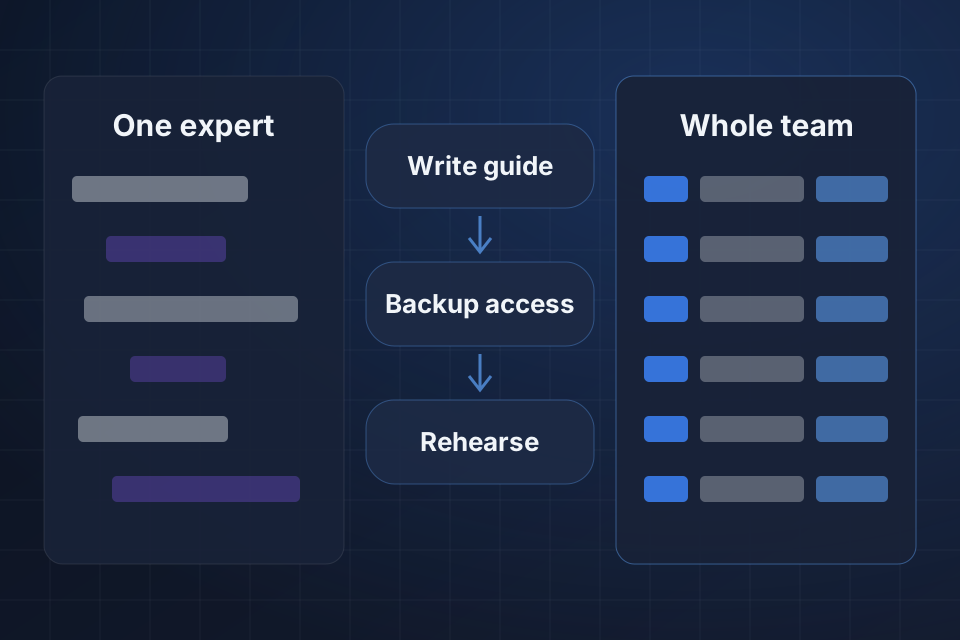
A familiar failure becomes a long interruption when the one person who knows the fix is away. Notes leave out decisions or backup permissions. We turn their knowledge into a guide and test it with another employee before it's urgent.
Discuss this problemWe watch a real or controlled recovery with your experienced person and record the evidence behind each decision. With the process owner, we review what access each step needs and when a step should go to someone with more authority. A backup colleague then follows the draft guide using their own assigned permissions. Wherever they have to guess or ask the original expert, we revise the instructions. The rehearsal confirms the final business outcome as well as the technical steps. We also assign an owner to maintain the guide when tools or rules change.
Your team waits for one particular person to clear a familiar failure. It turns into a long business stoppage, because nobody else has a tested way to work out the right next step.
Written instructions list the actions but leave out the evidence that shows whether they are safe. A colleague reaches a decision point and must guess or contact the original expert before going on.
A backup person understands the steps as written but cannot check logs or carry out the approved action. The guide stays unusable until its access needs and escalation duties get sorted out in practice.
We watch the recovery and record its decision points with your expert. The evidence they check matters, because the same visible symptom may need different actions depending on the state of the receiving system.
With the owner, we review permissions and escalation for each step. Some tasks can belong to routine staff, while privileged or ambiguous actions should stay with an admin or the person who owns that decision.
A backup colleague tries the current instructions on a controlled example. Their questions expose missing context and assumptions the original expert may apply automatically, without realizing the guide leaves them out.
We write a recovery guide that connects symptoms with evidence and approved decisions. It explains when to continue, when to check the state of the receiving system and when to stop and escalate.
We set up suitable backup access and name the people to escalate to. Nobody assumes broad admin rights are needed. Permissions follow the actual duties approved for each recovery step.
Another person rehearses all the steps with us, and we fix the gaps we see. We check the final business outcome, and an owner takes on guide upkeep so future platform changes do not recreate the dependency.
Not until it has been tested in practice. Another person should identify the failure and complete the approved recovery with their own access. That rehearsal shows unstated decisions and permission gaps before an absence forces your team to find them during a real interruption.
No. Permissions should match approved responsibility, not convenience. Some steps need escalation to an admin or process owner. We document those limits and test them, so the backup person can complete routine work without unnecessary control over unrelated systems.
Yes, we include meaningful variations and a safe path for unfamiliar conditions. A maintained guide also needs an owner who reviews changes in platforms or business rules. The goal is reliable decision support, not a static list that assumes every future failure will look identical.
Name the platforms and process involved. Share one failure example, with private details removed, and its usual recovery outcome, so we can identify the knowledge, access and decisions a backup person would need.
Explore Training & Enablement More problems in Training & managed support
Tell us about your project and we'll get back to you within 24 hours.