Records stop between systems
The first app holds the new record while a later system doesn't. Teams disagree about whether the job finished, because each one sees a different stage of the same business process.
Process automation
The first system updates fine, but a later step fails and nobody knows where work stopped. Rerunning everything risks another email or duplicate record. We rebuild step results, repair the real blocker, and provide a controlled path for unfinished work.
Discuss this problemWe compare one failed run with the evidence in each receiving system. A workflow status alone may not show which outside actions finished, especially when their responses were interrupted. At the first unfinished step, we trace dependencies and required fields. The recovery plan separates work that can be retried from reversals or compensation that need a process owner. After the fix, a controlled failure tests whether your staff can resume the remaining work without repeating earlier outputs.
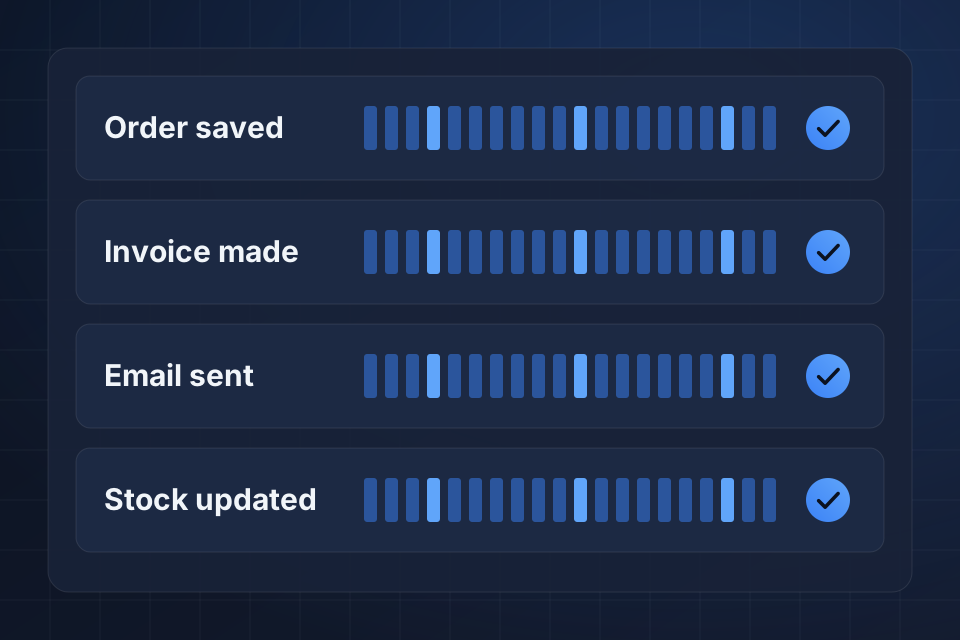
The first app holds the new record while a later system doesn't. Teams disagree about whether the job finished, because each one sees a different stage of the same business process.
The workflow reports a broad failure without showing which actions already finished. Whoever recovers it can't tell whether a message went out or a record was successfully created in the next system.
Your staff restart the whole workflow to finish one missing step. Earlier finished actions repeat, creating extra records or messages that now need their own cleanup and review.
We rebuild the run using its inputs, step results, and evidence from the receiving systems. This finds the last confirmed action and separates truly unfinished work from outputs whose confirmation got lost.
At the failing step, we inspect dependencies, including required fields and timing assumptions. A later action may run before an earlier output exists, or it may get a value the next system rejects.
We review how each outside action handles retries and reversals. Messages and financial operations need a clear recovery policy, because replaying the workflow can't reliably undo their earlier effects.
We keep confirmed step outcomes with safe references to the receiving system. A recovery attempt can then tell finished actions from pending steps, and it doesn't have to start the whole sequence again from its trigger.
We correct the confirmed mapping, access, or ordering problem at the blocked step. Then we check the revised dependency against typical input, including the condition that caused the partial completion.
You get an approved way to resume unfinished actions. Where reversal or compensation is needed, the process stops for its owner's decision and keeps the evidence needed to explain the resulting state.
Some can, while delivered messages or physical actions may need compensation instead. We agree on those decisions with the process owner before we build recovery. A blanket rollback promise would hide real differences between the systems involved.
We first assess whether your current platform can provide the step tracking and controls you need. We consider a replacement only where a proven limit blocks the agreed recovery behavior. That decision rests on practical evidence from this workflow, and not on a feature list alone.
A run reference with personal details removed and the expected final business result are useful. Include which apps already show successful work and the first visible missing output. That lets us compare the actual evidence in each system without asking for full data payloads that hold unrelated customer information.
Share the automation platform and affected apps, plus one run reference with personal details removed. Explain the expected final result and which outputs already exist so we can find the unfinished step.
Explore Process Automation More problems in Process automation
Tell us about your project and we'll get back to you within 24 hours.