Invoices repeat for one payment
Several invoices share one original payment reference, though the customer paid once. Finance must work out which document stands for the sale before deciding how to fix the extra records.
Payments
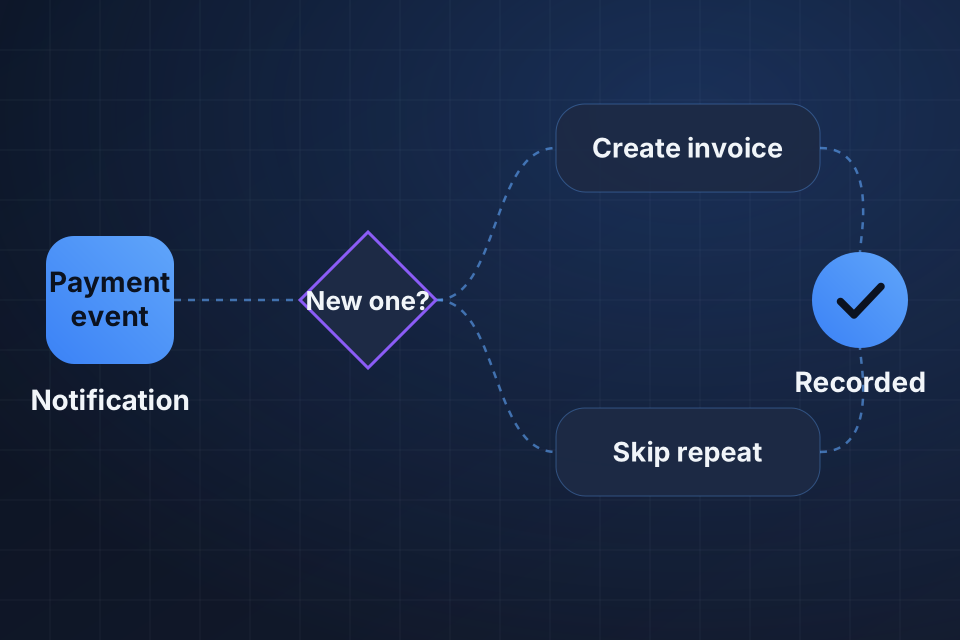
One payment creates several invoices or fulfillment requests because each message counts as new work. Retrying an apparent failure can repeat finished work. We check the payment and what it created, fix duplicate handling, and help owners review existing copies.
Discuss this problemWe compare event references, transaction IDs and the documents or requests they created. One event delivered twice differs from several events about the same payment, so duplicate protection must match the real business action. We also review breaks that happen after the other system creates a record but before it confirms. We test the new handling at those points. Existing duplicate invoices or shipments stay subject to finance or operations approval, because fixing them can have effects beyond the connector.
Several invoices share one original payment reference, though the customer paid once. Finance must work out which document stands for the sale before deciding how to fix the extra records.
Repeated payment messages create several warehouse requests for the same order. Staff need to tell repeat requests from truly separate goods still waiting to ship before they act on the queue.
A process reports failure after the other system has already created its output. Retrying creates another record, because the first result wasn't checked or kept at the point where it should have been confirmed.
We compare message and transaction IDs. One event sent many times and separate events for the same payment need different evidence to show whether another business action is really needed.
We find the gap between the record being created and success being logged. A break there can make finished work look absent when the next try decides what to create.
We inspect supported lookups or duplicate controls in the other system, using stable business references. The question is whether the intended invoice or release already exists, not merely whether an event arrived.
We record completed actions using a suitable payment or order ID. That record covers the real business output. It doesn't assume every separate message should create another invoice.
When a confirmation gets cut off, we check the other system before anything is created again. The supported approach keeps enough evidence to resume safely or show an unclear result for review.
We link existing duplicates to the payment that created them, for owner review. Finance or fulfillment decides the fix, while the new connector logic prevents the confirmed repeat pattern in new work.
Not necessarily. Event systems may retry messages, so the integration needs deliberate duplicate handling. We work out what marks a repeat delivery and what marks the business action. Different events can still relate to one payment and should not automatically create separate invoices.
That decision belongs to their owners. Duplicate invoices and shipments may have financial or operating effects, so owners decide whether to cancel, adjust or correct them another way. We keep the original references and show the evidence, rather than deleting business records solely because they look alike.
Not by itself. An event ID can spot repeated delivery, but several different events may describe the same payment as it moves along. We also inspect transaction IDs and the references on the resulting action, so the control protects the intended business output at the point where the repeat happens.
Tell us your payment service and the system creating duplicates. Share one redacted payment with its repeated invoice or fulfillment references, so we can find the business action that was repeated.
Tell us about your project and we'll get back to you within 24 hours.