Complex catalogs need a structure that can reflect how your products really relate to each other.
Your catalog doesn’t fit neatly into a flat list of fields. Some products share most details, some add optional ones, and others relate to each other. Forcing that into a simple structure means repeated entry and awkward workarounds.
Pimcore’s data model handles this through inheritance, variants and relationships. We design it using class definitions, field collections, object bricks and classification stores. In plain terms, we build the structure that represents your products accurately, so shared details are entered once.
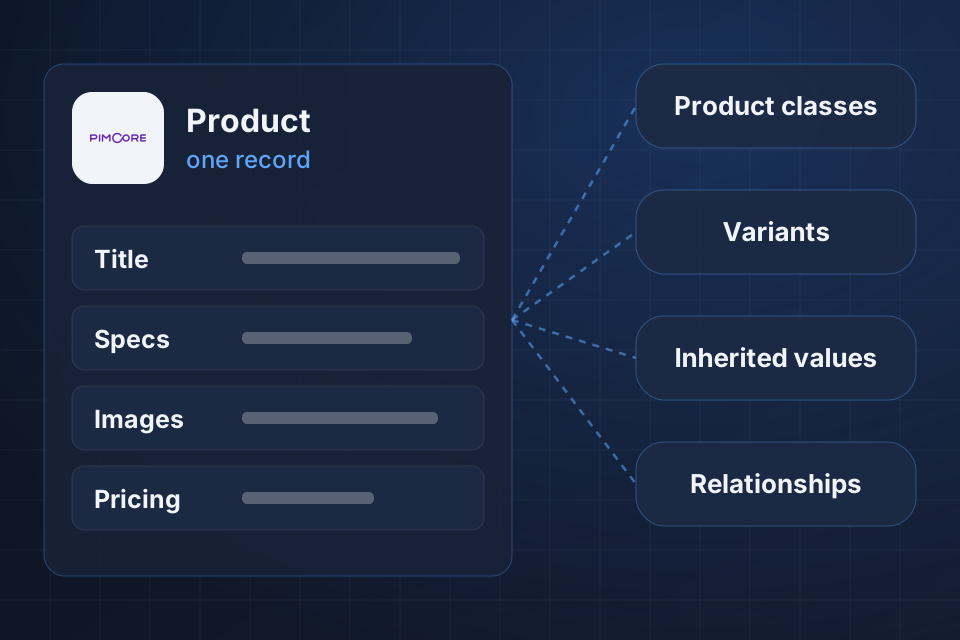
Class definitions, or templates, built for each product type
Inheritance, so child products reuse their parent’s data
Variants that share some details and differ on others
Clear links between related products and data
We look at your product types and how they relate, including hierarchies, variants and optional details.
Each product type gets a class definition, with room planned for extension from the start.
Parent objects pass attributes down to children, with overrides at any level where a variant differs.
Object bricks and field collections hold optional or repeating details, which keeps the main model clean.
We’ve deployed and optimized Pimcore for enterprise organizations. We know what the platform can do and where it gets hard, so we can pick a model that fits your catalog without needless layers.
Pimcore uses an object-oriented approach with classes, inheritance and polymorphism, where one structure can take several forms. That gives you more flexibility than attribute-based PIMs, especially for deep hierarchies and catalogs with many product types.
Object bricks add optional attribute groups to a class, like warranty info that only some products have. Field collections group related fields that repeat, like several ingredients, each with a name, percentage and origin. We use both to keep your model clean and flexible.
Yes. Pimcore’s inheritance system lets parent objects pass attributes to children, and you can override them at any level. That’s ideal for product lines where many attributes are shared and a few vary.
We plan for change from the start and use Pimcore’s migration tools to make schema changes safely. Every change is tested in staging before it reaches production.
Tell us about your project and we'll get back to you within 24 hours.