Celigo: Flow Design & Development

A Celigo flow is the pipeline that moves and reshapes data between systems. We build yours around your business rules.

Flows That Match Your Rules

Your records don’t all follow the same path. Some need a lookup in another system, some need splitting, and some go somewhere different depending on the details. A basic sync can’t carry that logic.

We design and build Celigo flows that handle your specific business logic. The work ranges from simple record syncing to multi-step orchestrations, meaning several connected steps that run in order. We add routing rules, data changes and lookups in other systems wherever your process needs them.
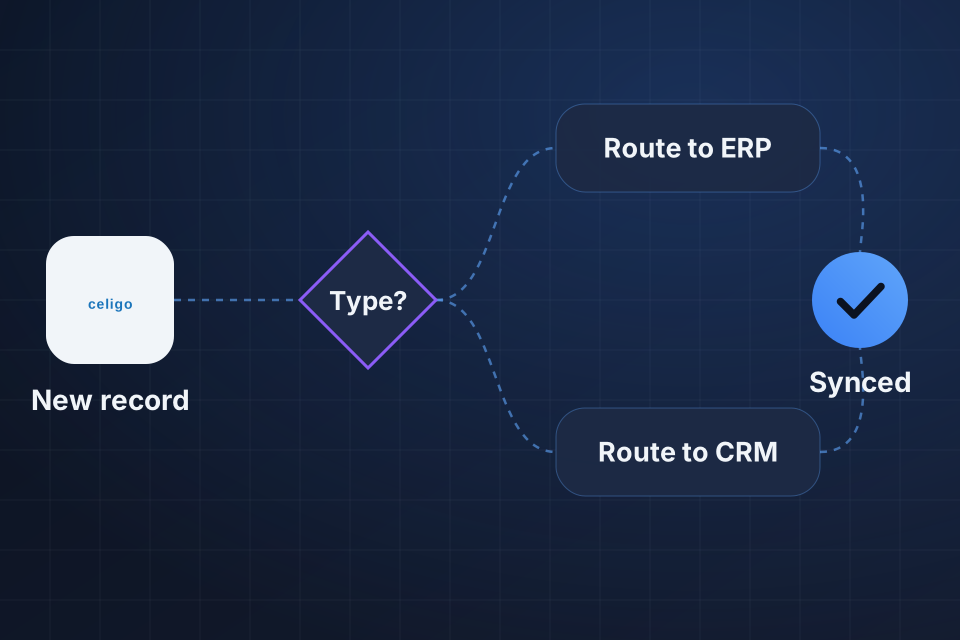
Diagram of a Celigo flow that takes a new record, checks its type and routes it to the ERP or CRM before syncing.

What Your Flows Can Handle

Custom flows built around how your business works

Complex data changes and field mapping

Rules that send each case down the right path

Lookups from one system to another

From Process Map to Flow

1

Map the Process

We trace each record through your business and write down the rules, exceptions and systems it touches.

2

Match the Fields

We map fields between systems and decide what needs Handlebars expressions, JavaScript hooks or lookups.

3

Pick the Timing

We choose real-time webhooks or scheduled batches based on your data volume and what your systems can handle.

4

Build and Sequence

We build each step in the right order, so events that touch several systems run with dependencies managed.

Why Choose System Strats

We bring deep Celigo integration experience and understand how to build reliable, scalable integration systems. We treat Celigo as a strategic platform, so each flow fits the wider system instead of solving one problem alone.

Frequently Asked Questions

A simple sync moves records between two systems with basic field mapping. A complex flow adds data changes, routing rules and multi-step lookups. It may also split or merge records and coordinate work across several systems.

Yes. Celigo supports real-time flows triggered by webhooks as well as scheduled batch processing. We recommend one or the other based on your data volume, how fresh the data must be and what your systems can handle.

We build transformation logic inside Celigo, using Handlebars expressions, JavaScript hooks and lookup functions to reshape the data. Harder cases may use Celigo’s custom scripting.

Yes. We build multi-system orchestrations where one business event triggers data flows across three or more systems, in the correct order and with dependencies managed.

Ready to Get Started?

Tell us about your project and we'll get back to you within 24 hours.