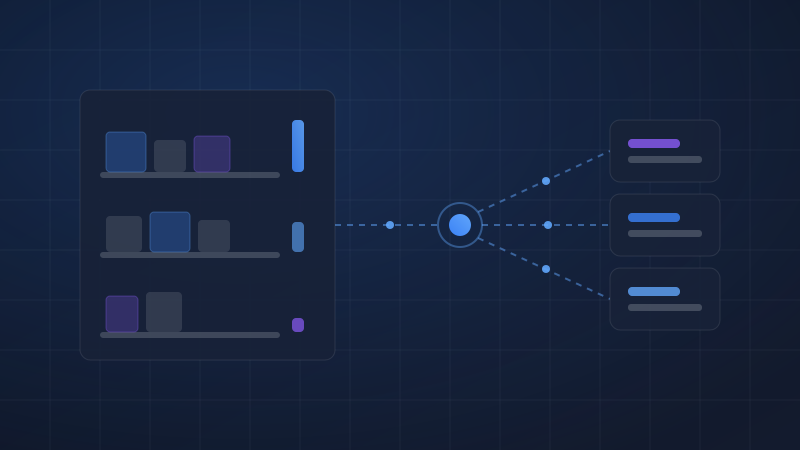
Walk into almost any small business and you will find the same thing: a set of spreadsheets quietly running the entire operation. One tracks customers and their contact history. Another tracks quotes and which ones are still open. A third handles inventory, a fourth schedules jobs, and a fifth is the one only Sandra understands, which is a problem because Sandra is on vacation next week. Nobody planned it this way. The spreadsheets accumulated one at a time, each solving a real problem on the day it was created, until together they became the business's unofficial operating system.
When owners look at replacing this setup, they usually check the obvious names first: Salesforce, HubSpot, NetSuite, Zoho. Then they see the per-seat pricing, the mandatory tiers, the implementation consultants, and the twelve-month contracts, and they quietly close the tab and go back to the spreadsheets. That reaction is understandable, but it rests on a false choice. The decision is not spreadsheets versus a five-figure annual platform commitment. There is a third path that most small businesses never seriously consider: a custom CRM or operations platform built specifically for how their business works. And thanks to how much software development has changed in the past few years, that path is often the cheapest of the three over any reasonable time horizon.
How Spreadsheets Take Over, and How They Break Down
Spreadsheets earn their place honestly. They are free or nearly free, everyone knows how to use them, and they can model almost anything. For a business with one or two people and a handful of customers, a well-organized spreadsheet is genuinely the right tool. The problems start with growth, and they compound quietly.
The first symptom is usually version conflict. Someone saves a local copy to work offline, someone else edits the shared version, and now there are two sources of truth that disagree about which quotes went out last week. Then comes manual re-entry: the same customer name typed into the contact sheet, the quote sheet, the invoice, and the job schedule, each entry a fresh opportunity for a typo that breaks a lookup somewhere else. There is no audit trail, so when a price changes or a row disappears, nobody knows who changed it, when, or why. There are no permissions, so the new hire has the same ability to delete the customer list as the owner does.
The most expensive symptom is the human bottleneck. In nearly every spreadsheet-run business, one person becomes the keeper of the system. They built the formulas, they know which columns are safe to touch, and every question about the numbers routes through them. When that person is out, decisions stall. When that person leaves, the business loses institutional knowledge it never realized was concentrated in a single head. And underneath all of it, nothing is automated. Follow-ups happen only if someone remembers. Reports exist only if someone builds them on Friday afternoon. The spreadsheet does not do anything on its own; it just sits there waiting for humans to move information in and out of it by hand.
Why the Big-Name Platforms Cost More Than the Pricing Page Says
The established platforms solve every one of those problems, and for the right business they are worth every dollar. But their pricing models were designed for companies larger than most small businesses, and the sticker price is only the beginning.
Per-seat pricing is the first multiplier. A plan that looks reasonable at forty or ninety dollars per user per month becomes a different conversation when you have eight people who need access. The features you actually need are the second multiplier, because they are rarely in the entry tier. Basic workflow automation, custom reporting, and permission controls tend to live one or two tiers up, which means the realistic per-seat number is often double or triple the advertised one. Then comes implementation. Platforms like Salesforce and NetSuite are not products you sign up for and start using; they are toolkits that a certified consultant configures for you, and mid-market implementations routinely cost more than the first year of subscriptions. Finally there is the feature overhang: you will pay, every month, forever, for territory management, forecasting modules, and enterprise marketing suites that your ten-person business will never open.
None of this makes the big platforms bad. It makes them mismatched. They are priced and architected for organizations that need what they offer at the scale they offer it. A small business adopting one is buying a commercial kitchen to make family dinner, and the monthly bill reflects the kitchen, not the dinner.
The Third Path: Software Built Around How You Actually Work
A custom CRM is exactly what it sounds like: a web application built for your business, containing the screens, fields, and workflows that match your actual process, and nothing else. Your pipeline stages are your pipeline stages, not a generic template you have to relabel and work around. Your quote format is your quote format. If your business schedules crews, the system knows what a crew is. If your jobs have a site-visit step before quoting, the software reflects that instead of forcing you to fake it with a custom field and a shared understanding.
This is the point that gets lost in most software evaluations: with off-the-shelf platforms, the business adapts to the software. Teams change their terminology, restructure their process, and invent workarounds to fit the tool. With custom software, the software adapts to the business. That difference sounds philosophical, but it shows up in hard numbers, because adoption is the single biggest predictor of whether a CRM investment pays off. A system that mirrors how your team already works gets used. A system that fights them gets abandoned, and an abandoned CRM is the most expensive kind, regardless of what it cost.
The most expensive CRM is not the one with the highest subscription. It is the one your team refuses to use, because then you are paying for the software and still running the business on spreadsheets.
What a Custom CRM Realistically Includes
Custom does not mean starting from a blank page or spending months in development. The core of what most small businesses need is well understood, and a system covering everything described below can typically be scoped, built, and launched in about a month. A competent build covers it as a baseline. Contact and company management with full interaction history. A visual pipeline for deals or jobs, with stages that match your sales process. Quoting and estimates, generated from your actual price list and sent as branded PDFs. Task automation for the follow-ups that currently live in someone's memory: quote sent three days ago with no response triggers a reminder, job completed triggers an invoice task, new lead from the website lands in the pipeline automatically with the salesperson notified.
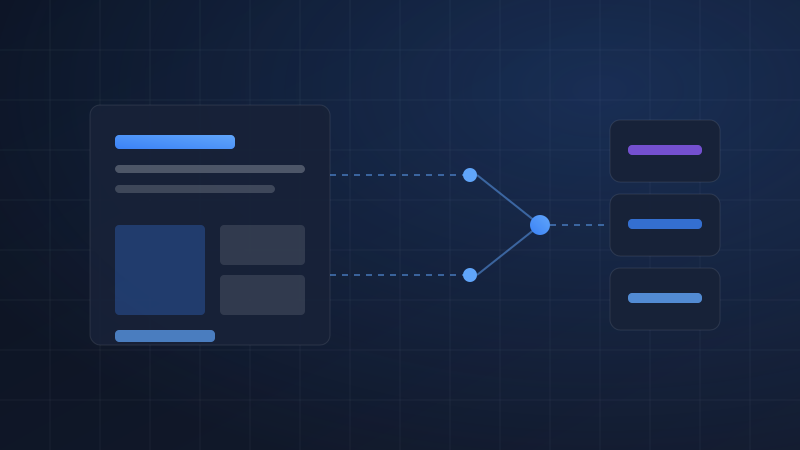
Integrations are where a custom build quietly outperforms its price. Website lead forms flow straight into the system instead of into an inbox. Email connects so correspondence attaches itself to the right customer record. Accounting sync pushes invoices to QuickBooks or Xero so nobody types the same numbers twice. Reporting pulls from one database instead of five spreadsheets, which means the Friday-afternoon report compilation ritual simply stops existing.
And because the system is yours, it grows on your schedule. When you add a service line, the software changes to match, and the change costs a small development task rather than a platform migration or a new module subscription. There are no per-seat fees, so adding your ninth employee costs nothing. You own the data outright, in a standard database you can export any time, which eliminates the vendor lock-in question entirely.
The Honest Math: Subscriptions Forever Versus Building Once
Here is the comparison that matters, laid out honestly. A mainstream platform for a team of eight, on the tier that includes the automation and reporting a real business needs, commonly lands between eight hundred and two thousand dollars per month once add-ons are included. Over five years that is fifty thousand to well over one hundred thousand dollars, plus implementation costs at the front, and the meter never stops. The subscription in year six costs the same as year one, and you exit with nothing you own.
A custom CRM inverts that structure. There is a one-time build cost up front, then modest ongoing costs: hosting that typically runs twenty to one hundred dollars per month, and a maintenance arrangement for updates and small improvements. The build is the number that historically scared businesses away, and this is where the landscape has genuinely changed. Modern frameworks, mature open-source components, and AI-assisted development have compressed the cost and timeline of custom software dramatically. Work that required a team of developers and six months a decade ago is now delivered in about a month, which means you are not trading a long development project for the subscription savings. You can be off the spreadsheets and running on your own system before the next big-platform invoice would have arrived. The unglamorous parts of a CRM, the forms, tables, authentication, and standard integrations, are largely solved problems, which means development effort concentrates on the part that is actually unique: your workflow. A custom system of the scope described above now frequently costs less than two years of big-platform subscriptions for the same team, and every year after that, the comparison only gets more lopsided.
Be honest about the other side of the ledger too. Custom software has a single point of accountability: your development partner. You should ask who maintains it, what happens if the relationship ends, and whether you receive the source code and data outright. Any credible firm will answer those questions in writing. If they will not, keep looking.
When Custom Is Not the Right Answer
Custom development is a strong option, not a universal one, and it is worth being clear about where it loses. If your needs are genuinely standard, a solo consultant tracking contacts and follow-ups, a very small team running a simple linear pipeline, then an off-the-shelf tool on a low tier is cheaper and faster, and you should use one. If you have fewer than three users and no unusual workflow, the math rarely favors building. If you need a sophisticated marketing automation suite on day one, with multi-step nurture campaigns, lead scoring, and A/B testing, buy a platform that has spent a decade building that, because recreating it is exactly the kind of custom project that fails.
The custom path wins in a specific and very common situation: a business of roughly three to fifty people whose operations do not fit a template. Businesses that quote custom work, schedule jobs or crews, track inventory alongside customers, or run a process with steps that no off-the-shelf pipeline quite matches. These are the businesses currently paying the highest spreadsheet tax, because they are exactly the ones the generic tools serve worst.
If that describes your business, the practical first step costs nothing: list the spreadsheets you run on, note who maintains each one, and estimate the hours per week spent retyping, reconciling, and chasing information between them. That number is what you are already paying for software, except the software is people, and it does not scale. Compare it against a fixed quote for a system built around your process, then against five years of platform subscriptions for your team size. For most spreadsheet-run businesses, that comparison is not close, and it points somewhere most of them have never looked.
JF
Jared Fraley
Co-Founder at System Strats
Jared helps businesses build technology strategies that actually work. With deep experience across custom software, CRM implementations, integrations, and automation, he focuses on solutions that drive measurable results without unnecessary complexity.